FizjoStyl: two physiotherapy clinics, one system
I co-own FizjoStyl, two physiotherapy and osteopathy clinics in Kraków. Since October 2026 I’ve led the AI transformation and the business side, while Konrad leads the clinical side and the therapists. In seven weeks we changed how the clinics find, serve and keep patients, and how the team works.
How the system works
Everything runs in three steps. Data comes in from the places patients and money already pass through. One system turns it into work for eight areas, each with its own AI role and a person in charge. What comes out reaches patients, therapists and the partners, every day.
1Data comes in
- Google and AI assistants
- ZnanyLekarz and Booksy
- The clinic booking system
- Our website and online booking
- The bank and invoices
- Public data on the market
2One system, eight areas
3What comes out
- Patients get confirmations, reminders and a link to rebook
- Therapists see every visit on their phone within minutes
- Reception gets a ready list of what to do today
- Google gets answered reviews and better pages
- Partners get one queue of decisions and a Monday report
Tap an area to jump to its chapter.
How we got here
We didn’t start with AI. We started by getting the numbers straight, then made sure the missing data was captured at all, and only then automated and handed areas to AI roles.
Swipe for earlier months ←
- Diagnosis. About 40 narrow AI analysts looked at the market, competitors, demographics and our own numbers. The verdict: demand was fine, but the clinics weren’t keeping track of where patients came from or whether they came back.
- One place for every number. Bank statements, ledgers, invoices and booking exports in one database, and every number has a source.
- Capture what was missing. A link to the booking system and the bank, a text-message service, our own reception panel and our own online booking.
- Automation. Reminders, review drafts, therapist alerts, ad limits: 130 automated tasks.
- AI roles. 26 AI assistants, each covering one area with its own targets and a human owner, and one queue for approvals.
- Growth engines. Hiring, vouchers, doctor referrals, the market microscope, acquisitions and onboarding.
Area 1
Marketing and new patients
Since October we went from paying commission for most new patients to bringing in most of them through our own website and Google.
A website that books
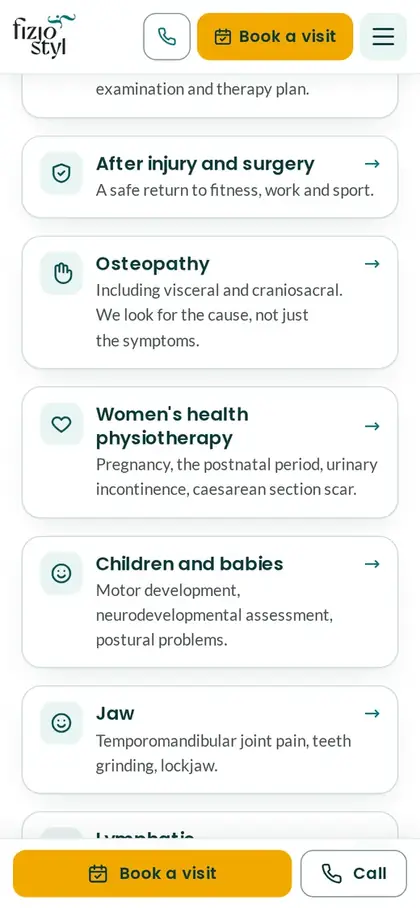
We improved every page instead of rebuilding the site: 58 pages, about 100 answers to real patient questions, and full therapist profiles in Polish, English and Ukrainian. Every button goes straight to a therapist’s free slots, and on a phone the booking bar never leaves the screen.
Our own online booking
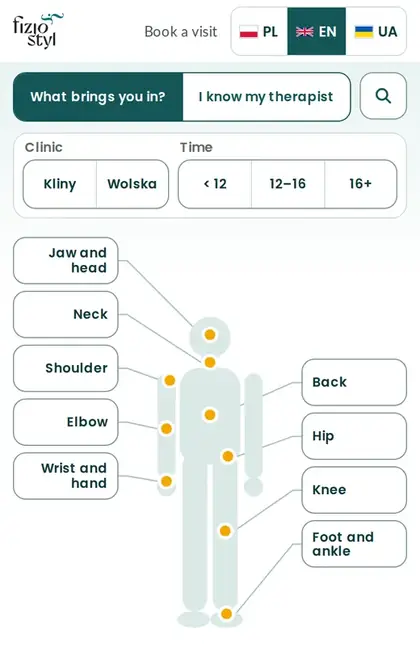
The old external form created visits with no patient attached. In our own booking, patients tap where it hurts, see therapists with free hours first and confirm with a text code. The visit lands in the clinic calendar with its source. 46% of online bookings happen before 08:00, after 20:00 or at the weekend, when nobody would pick up the phone.
Knowing where every patient comes from
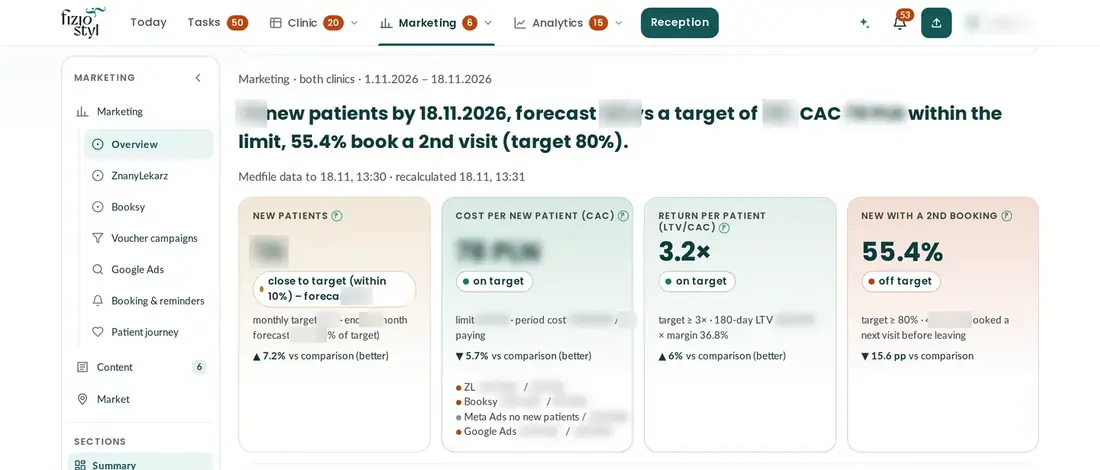
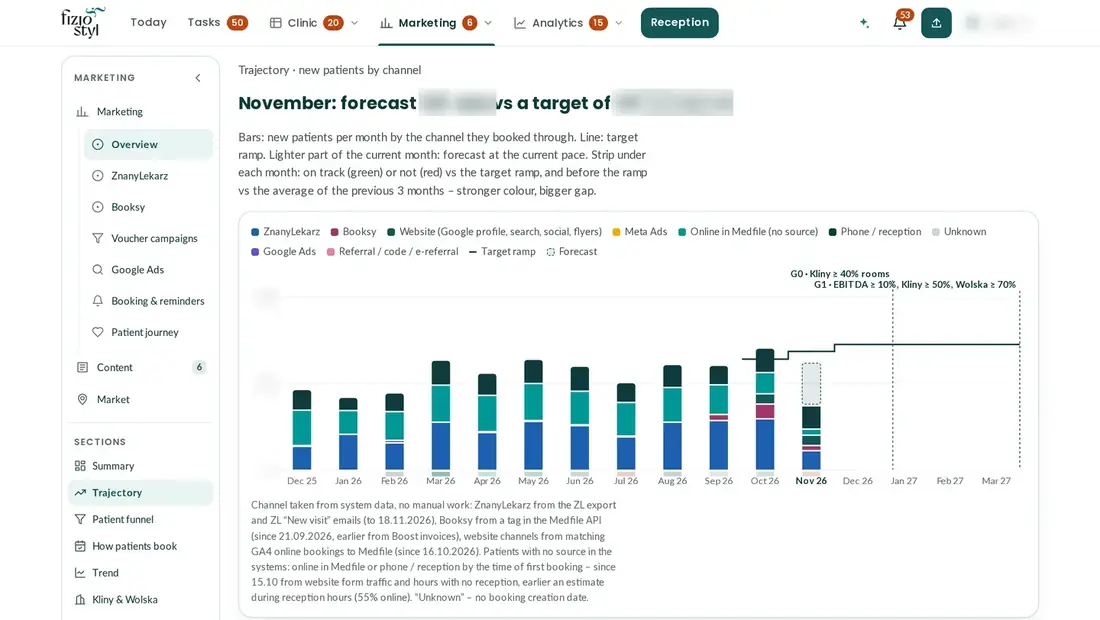
In September we didn’t know where almost a third of new patients came from. Now every booking records its source, and 82% of platform bookings (1,099 of 1,337) are matched to visits automatically.
Own channelsBooking platformsUnknown
Swipe for earlier months ←
Share of new patients each month, 2026. * November is 1–18 Nov.
Swipe to see the whole screen →
Swipe to see the whole screen →
Search: about 12× more visible on Google
New pages, answers and fixes went live on 10 October. The number of times we appear in Google results each week (impressions) grew from about 2,700 on average in September to 31,333 in the week of 10 November. Clicks grew 3.5 times, and clicks from people who didn’t search for our name grew 4.4 times. The blog went from 7 to 17 posts a week, each researched and checked before it goes out.
Swipe for earlier months ←
October 2025 to 16 November 2026. Part of the November peak is blog traffic from all over Poland, which rarely turns into visits.
Ads that can’t overspend
Search ads run on an autopilot with a hard monthly cap. Every day it removes junk searches, pauses keywords that spend without bookings and reports only completed bookings back to Google. Social ads for patients were switched off once the numbers showed they lost money.
Social and video
An autopilot for short videos took YouTube from 0 to 3 posts a week. Instagram reach grew 68%, and a message with the word “TERMIN” gets a booking link instantly.
Showing up in AI answers
Some patients now ask an AI assistant, not Google. We wrote a short description of the clinic for AI, including when to recommend us and when not to, and a plain-text version of all 188 pages. Once a month the same ten patient questions are asked automatically.
“Can you recommend a good osteopath in Kraków? I live in Kliny.”
One assistant with web search, one run per date. On independent web search we went from 2 to 8 of 21 tracked phrases in the top ten.
Decoding ZnanyLekarz
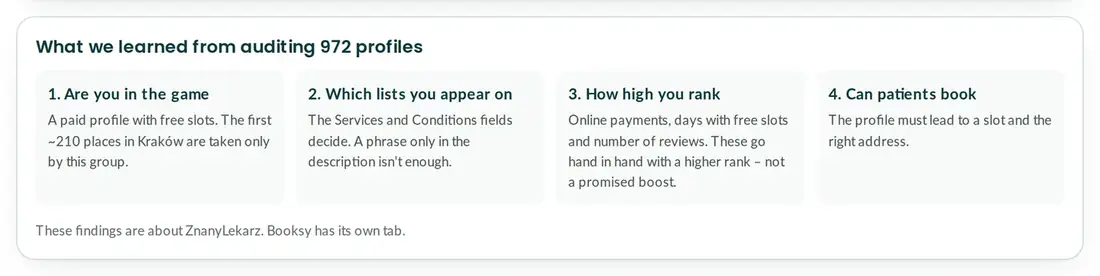
ZnanyLekarz, Poland’s biggest booking platform, brought us over 40% of new patients this year, so we studied what decides who shows up first. Over two nights we read 842 public list pages (16,148 listings, 972 profiles). We repeated reads to measure noise, and two independent reviewers checked the method.
Places gained among comparable profiles. “Association” means profiles with this feature rank higher, but we couldn’t prove it causes it.
- Photos, replies to reviews and fresh reviews don’t move the ranking at all.
- A condition written in your description does nothing; only the right code in the profile fields gets you onto that list (0 of 12,302 listings without it).
- Seven of our eight ZnanyLekarz profiles showed “free consultation” instead of a price. None of 313 comparable profiles did.
Swipe to see the whole screen →
Every therapist got a personal profile pack with before-and-after screens, and we are now first on two district lists. Bookings from the platform haven’t moved yet, so the honest status is: mechanics decoded, effect still to prove.
Area 2
Patients and retention
Getting a patient is expensive; keeping them is where a clinic wins. Since October every step after the booking has a message, a link or a reminder.
A text at every step
Confirmation, a reminder two days before, directions and parking two hours before a first visit, a new date with the same therapist after a cancellation, a one-tap rating, and on day three, if there is no next visit, two free slots to choose from.
11–17 November 2026. 99% delivered; 89% of patients open the first-visit rating.
Links instead of phone calls
Every text carries a personal link to confirm, move or cancel. The change goes straight into the calendar, so nobody types it in, and the freed slot is open for someone else.
The second visit
The strongest habit we found: patients who book their next visit before leaving have 2.4 times as many visits in six months. Our two clinics, Kliny and Wolska, differ a lot here, so we know where to push, and every therapist sees their own number every Monday.
Area 3
Reception and operations
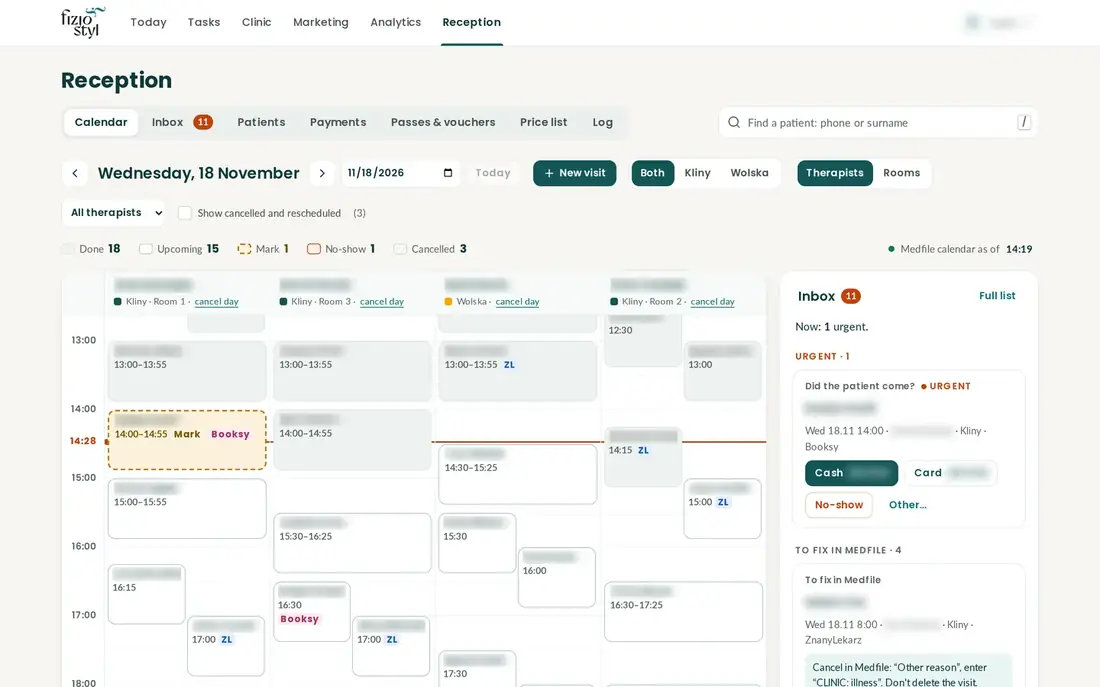
We wrote our own reception panel on top of the booking system. Everything a front desk does sits on one screen, and most of it happens on its own.
Swipe to see the whole screen →
No visit left unmarked
Ten minutes after a visit starts with no status, its tile turns into an urgent “Did the patient come?” card with one-tap payment. A no-show can only be marked from then on, so nobody marks it too early.
Late arrivals
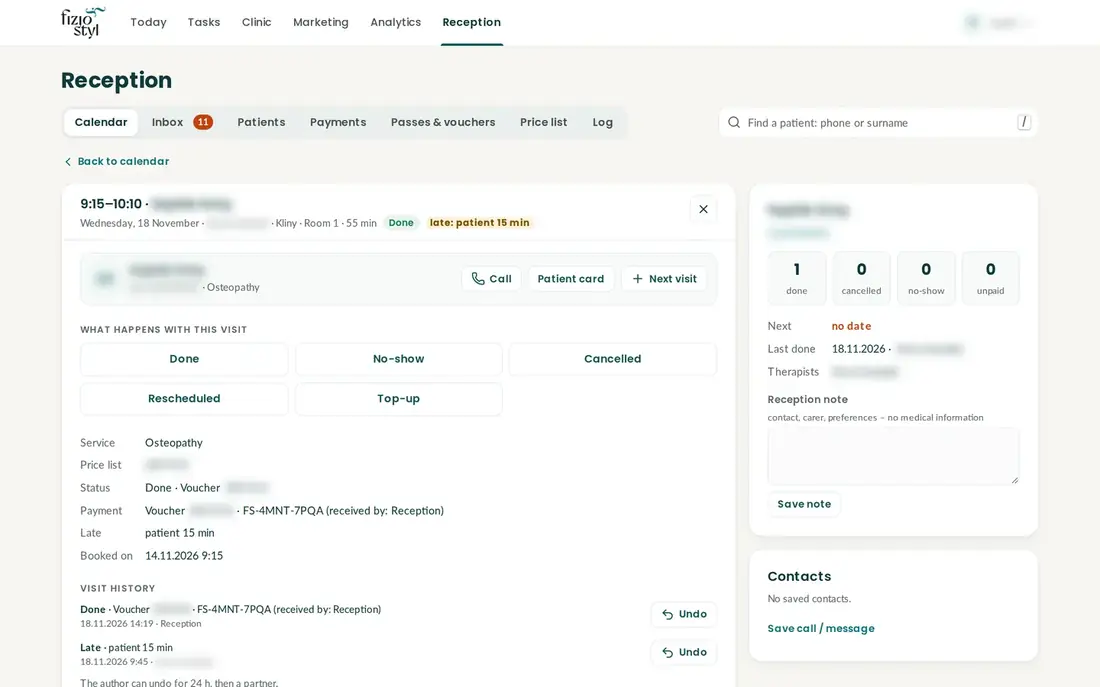
Logged on the visit with one tap and visible in its history, so we can see patterns instead of arguing about them.
Swipe to see the whole screen →
Gift vouchers and visit packages
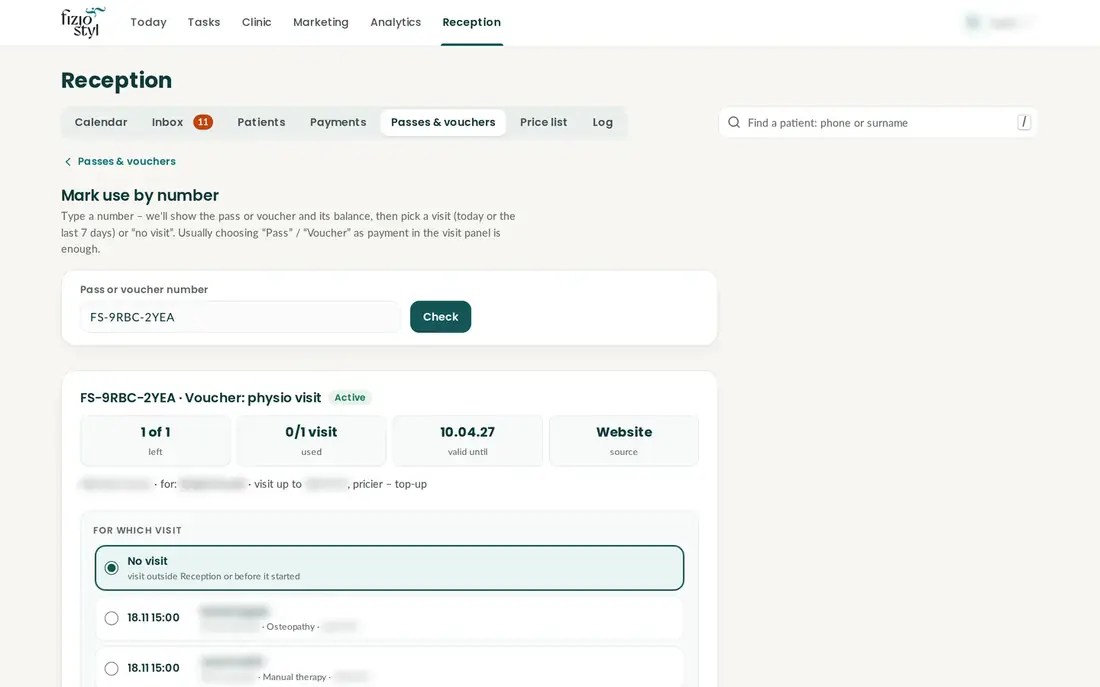
Gift vouchers are sold online and imported on their own. Reception types the code, sees the balance and expiry, and the visit is deducted automatically. If the visit costs more than the voucher, the patient pays the difference.
Swipe to see the whole screen →
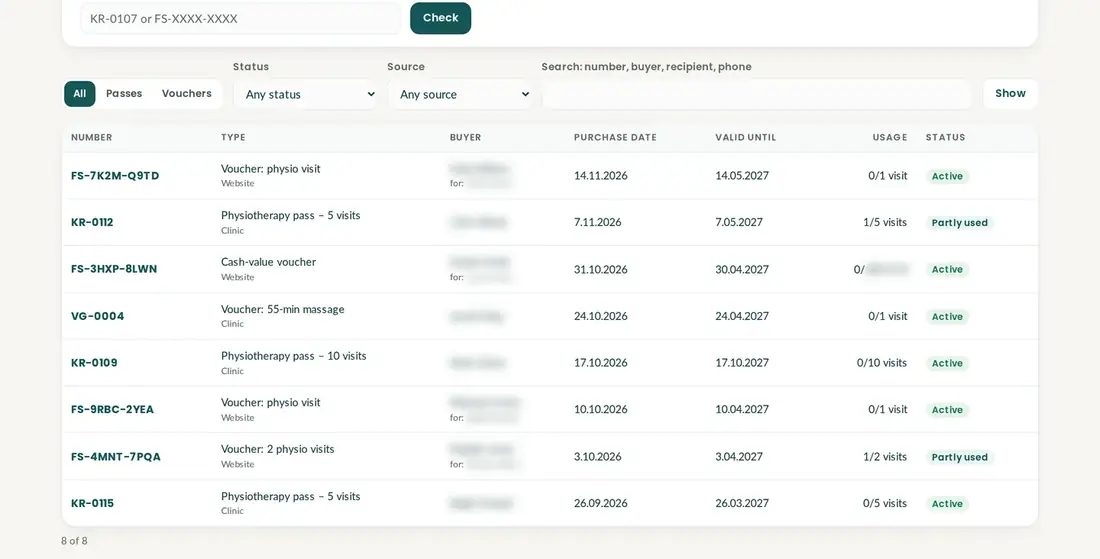
Swipe to see the whole screen →
Call-backs that build themselves
A no-show or a cancellation opens a call-back on its own. Doctor referrals and treatment plans land on the same list, and each row closes itself when the patient rebooks, or after three tries.
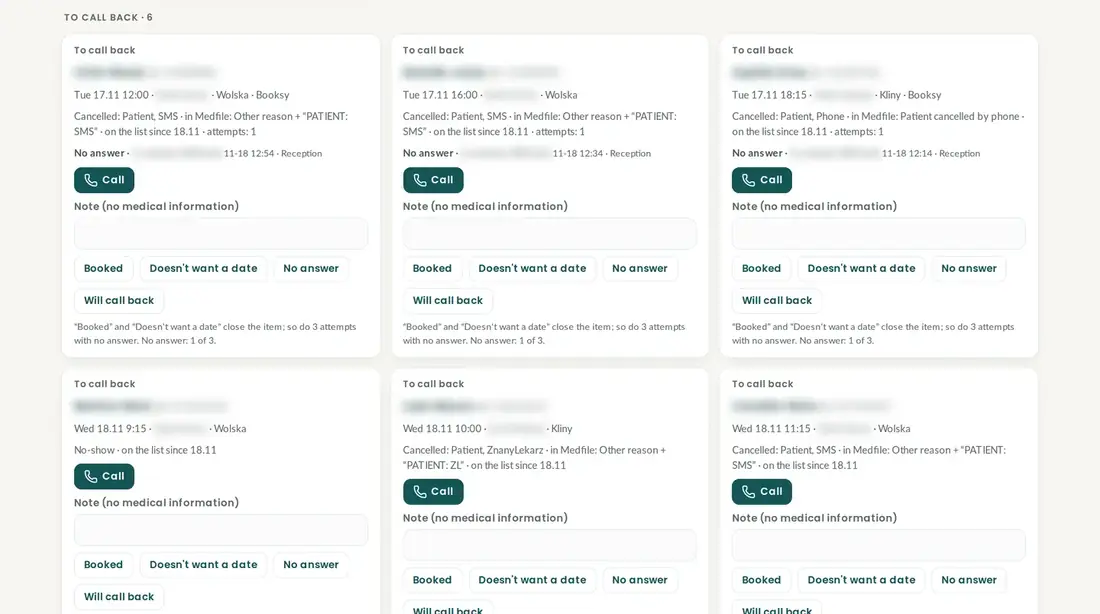
Swipe to see the whole screen →
Two calendars kept in sync
The panel checks the booking system every minute and every online slot every hour: 29,115 of 29,115 match. Payments are matched to the cash box, and bank transactions are sorted into categories four times a day. Wolska runs without a full-time receptionist.
Area 4
Reviews and credibility
Patients choose a physiotherapist they can trust. We made sure every place they look shows a clinic that answers, explains and is easy to check.
Every review answered
New reviews are checked every hour and AI drafts a reply in the clinic’s voice for approval. From the third visit on, patients get a polite request for a review.
★★★★★
“I highly recommend FizjoStyl! It was my first ever visit to a physiotherapist and after the very first session I feel a huge difference and relief. The clinic is beautifully designed and the whole team is extremely professional and friendly.”
★★★★★
“A professional visit. Kamil Z., one of our physiotherapists, did a thorough functional assessment, explained the cause of the problem in detail and laid out a plan for further rehab.”
★★★★★
“I'm very happy: literally a few visits were enough to solve my problem. Karolina explains everything carefully and has a great way with patients :)”
Swipe for earlier months ←
Both clinics. * November is 1–18 Nov.
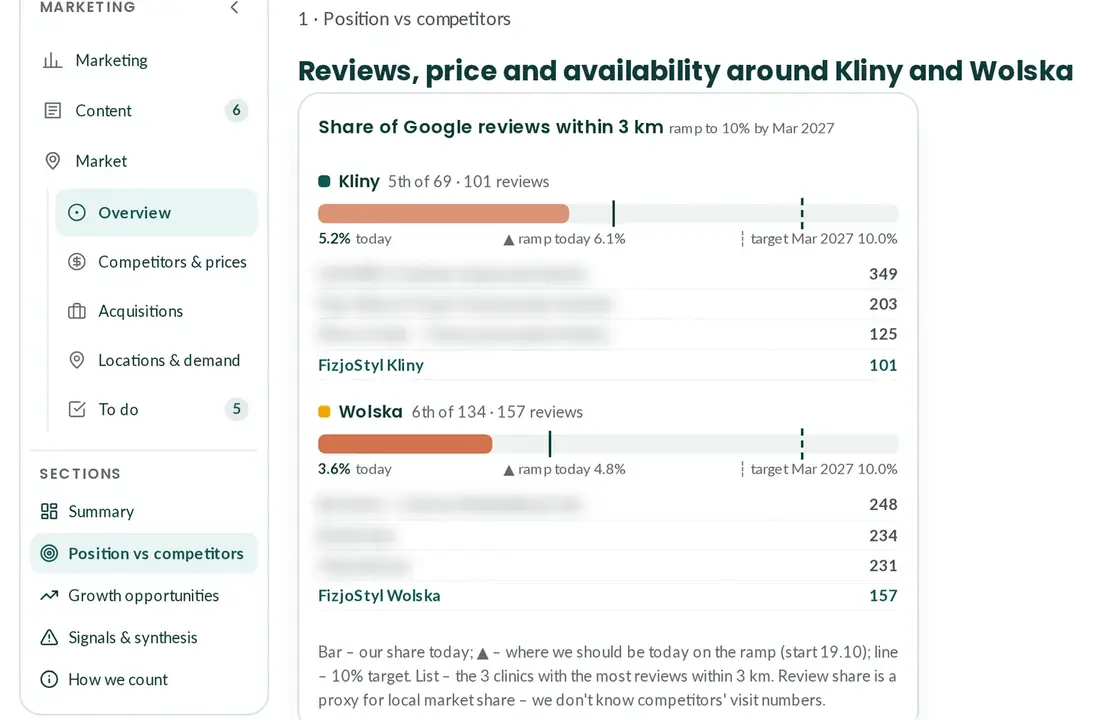
Swipe to see the whole screen →
Therapists you can check
Nine full profiles in three languages, with licence numbers, education and what each therapist treats. The word patients use most in 5-star reviews is “approach”, and more than half name their therapist, so we put the people first.
Platform profiles fixed
Each therapist got a profile pack for ZnanyLekarz with exact steps. 17 of 32 fixes are live, and we appear on 12 condition lists instead of 10.
Honest answers for AI
The description we wrote for AI assistants also says when not to recommend us: no visits paid by the national health fund (NFZ), no Sundays. We think honest limits make a recommendation more likely, not less.
Area 5
Therapists
A therapist should treat patients, not chase calendars. Since October most of the admin around a visit has moved off their plate.
Every change on their phone
A new, moved or cancelled visit reaches the therapist within about two minutes, as a phone notification, an e-mail and a bell in the dashboard. Tomorrow’s plan arrives at 19:00. In one week that was 46 phone notifications and 218 alerts.
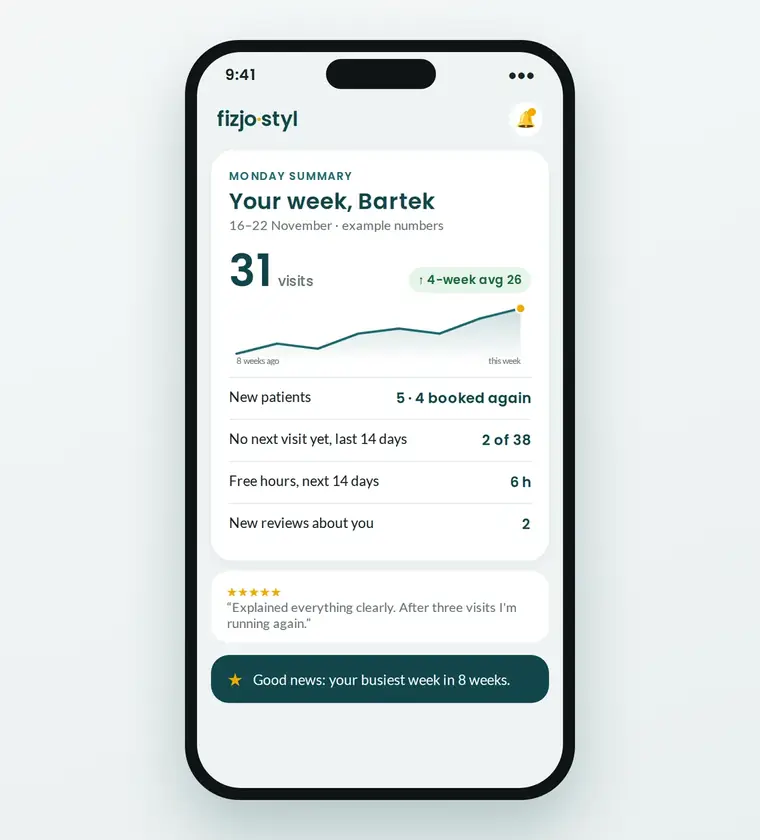
Their own progress, every Monday
Visits against their own 4-week average, new patients who booked again, patients with no next visit yet, free hours and new reviews about them.
It ends with one piece of good news, like their busiest week in two months. No money and no rankings: each therapist only sees their own progress.
Less admin around every visit
Patients confirm and move visits from a text, reception marks statuses with one tap, vouchers deduct themselves and the call-back list writes itself. Most things that used to need a phone call now happen on their own.
Coaching, not control
Every Friday the owner gets short notes for one-to-one talks, built from each therapist’s own numbers. The aim is a better conversation, not a scoreboard.
Area 6
Hiring and team
Growth needs therapists. We turned hiring into a steady flow of candidates, and joining the team into a path that runs largely on its own.
Hiring on autopilot
A careers page with clear job ads, and applications from four mailboxes landing in one place. AI scores each one against a scorecard and drafts a reply within 15 minutes; a person sends it. Every Monday a database of 1,267 public therapist profiles suggests up to five people worth contacting.
Onboarding (launched November 2026)
When a new therapist joins, the system sets them up in about 45 places on its own: accounts, booking, the reception panel, notifications, the website profile. The new version turns the whole start into a self-service path:
- 1A partner sends an invite
- 2The new therapist logs in with an email code
- 3They fill in a form, step by step
- 4Partners approve each part
- 5A contract is generated
- 6They sign online with a government e-ID
- 7The owner countersigns
- 8Accounts, booking, website profile and alerts are set up
Area 7
Management, data and AI
Underneath everything sits one system: every number in one place, an AI role for every area, and people making the decisions.
From eleven spreadsheets to one screen
Bank statements, ledgers, invoices, booking data, Google, ads, platforms and public registers flow into one dashboard. Every number has a source, and an automatic check verifies it before anyone sees it.
AI roles with targets
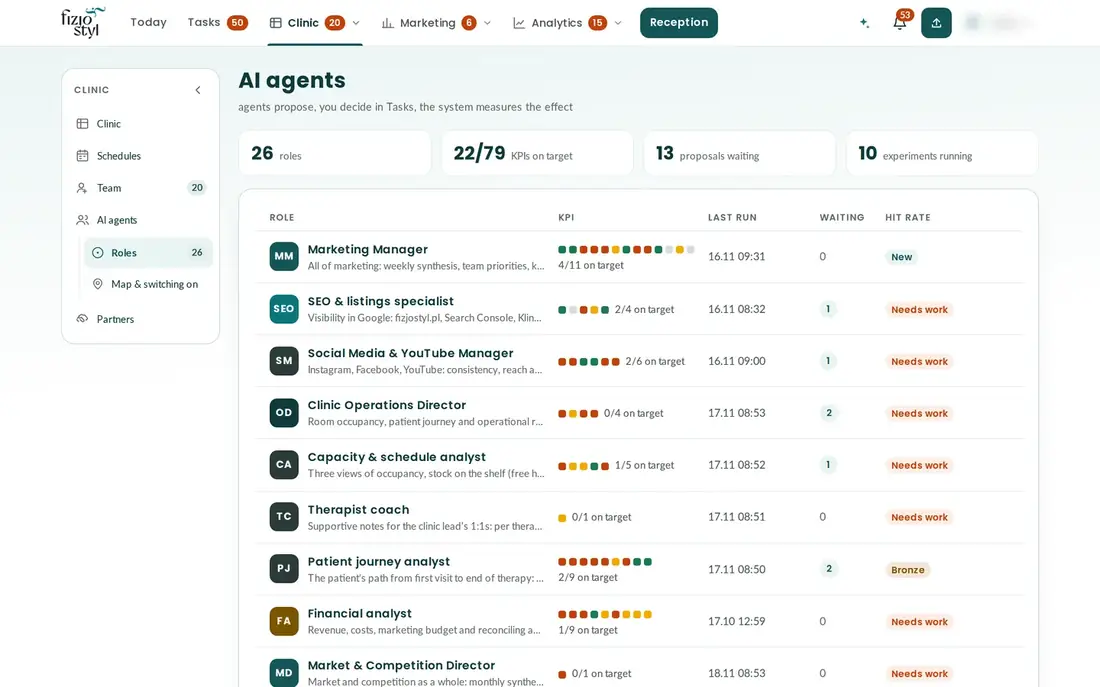
26 AI assistants, each covering one area (we call them roles), from marketing and search to retention, finance, hiring and IT. Each watches its own targets and proposes actions; one queue holds everything that needs a human yes. The dashboard says plainly that most roles still “need work”.
Swipe to see the whole screen →
Checks before we grow
Before we grow, each clinic has to hit a set of targets: returning patients, lost visits and the quality of first visits among them.
130 automated tasks, all visible
Every automated task has an owner, a schedule and a status, and anything that fails is flagged at the top of the screen instead of buried in a log.
Results, measured
September, the month before I joined, against the latest month or week:
Change in %. Not everything went up: actions on Google listings fell 19% and visits from social media fell 67%.
Area 8
Market and growth
To grow beyond two clinics you need to see the whole market. So we built a microscope on it, and a map of where to grow next.
A microscope on the market
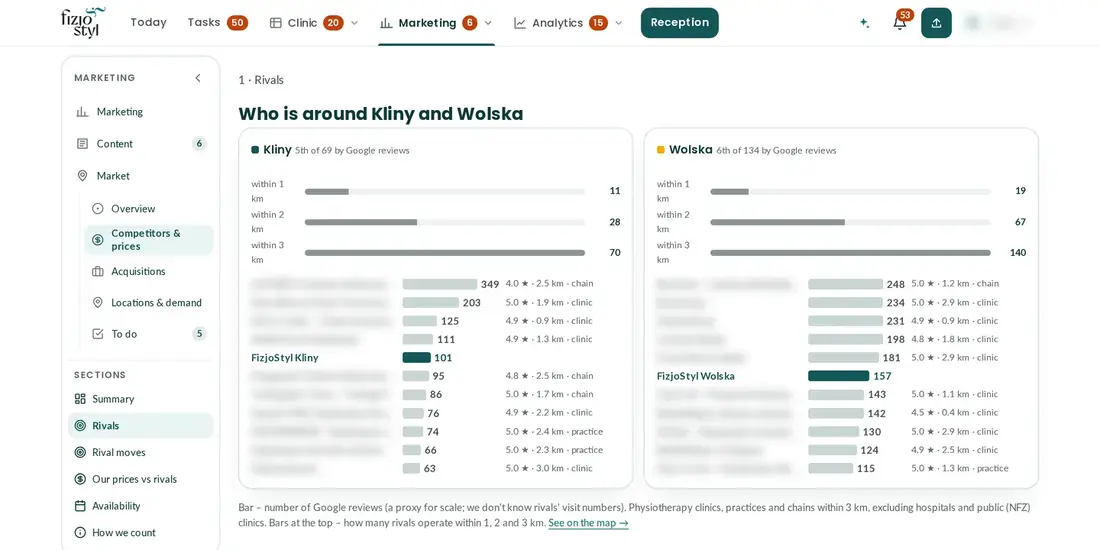
Several times a day we read the public calendars of about 600 Kraków therapists across five booking systems. Checked against our own calendar, the method lands within one percentage point of reality.
median wait for physiotherapy paid by the national health fund (NFZ) in Kraków, with 35,093 people in the queue. Our new patients are seen within 1–2 days.
is the busiest day in competitors’ calendars (43% booked); Wednesday and Saturday are the quietest (25–28%).
of 685 clinic websites in Kraków have no online booking, and 56% have no analytics at all.
The most expensive first visit in Kraków costs 7.5 times the cheapest, yet junior and senior therapists charge the same median price.
Swipe to see the whole screen →
Joining clinics
We scored every physiotherapy practice in Kraków on size, quality, growth, location and risk. Of 1,223, 14 fit our ideal profile, and about ten are realistic candidates.
Screening, autumn 2026. The top three stayed on top in every random re-weighting of the score.
Doctors and companies
A referral portal for doctors is live, with QR codes and, with the patient’s consent, a report after the first visit. 318 medical facilities are screened and 52 are ready to contact. 305 workplaces near the clinics are mapped for an offer built on our empty morning hours.
If you run a clinic
This is what changes for a clinic that joins us:
- No phone calls the day before. Patients confirm, move or cancel from a text.
- No typing cancellations, no paper voucher register, no checking two calendars.
- Therapists see every new visit on their phone within about two minutes, and their own progress every Monday.
- Reviews get answered, platform profiles get fixed, and the website, ads and AI visibility are handled.
- A clinic can run without a full-time receptionist, like Wolska does today.
- Nothing changes for patients or therapists on day one.
If that sounds interesting, write to me at [email protected].
Not working yet, but will
- Doctor referrals. The portal is ready and 52 practices are ready to contact. No referrals yet, because nobody is visiting doctors yet.
- Using the new tools every day. 52% of November visits still have no status and 74 call-backs are overdue. The bottleneck is now habits, not tools.
- Doctors and dentists need people, not software. The portal works, but the first visits to practices are still ahead of us.
Where I see the biggest growth
The plan for the next months, step by step:
December 2026
- Make the second visit a habit. Book the next visit before the patient leaves, every time, with each therapist’s own number in “Your week”.
- Gift vouchers for Christmas. The shop, codes and redemption are ready.
- Finish the platform fixes. All 32 ZnanyLekarz changes, with bookings tracked list by list.
January 2027
- Walk into doctors’ and dentists’ practices. Start with the 52 ready to contact, with QR codes and the first-visit report.
- Follow the demand into the evenings. Shift schedules towards afternoons and evenings, when Kraków books first.
February 2027
- Offer companies our mornings. A simple package for the 305 workplaces near the clinics.
- Hire for the busiest hours. Hiring and onboarding are ready for new therapists.
March 2027 and on
- Join clinics. Talk to the owners of about ten clinics that fit, and offer the whole system from day one.
- New services and AI answers. More answers for AI assistants, and new services where the data shows demand.
Why conservative businesses have to change
Physiotherapy is a traditional business: good hands, a phone, a paper calendar and word of mouth. That worked for decades. It won’t for much longer.
- Patients have already moved. Almost half of our online bookings happen when nobody would pick up the phone. Some patients now ask an AI assistant, not a friend, where to go.
- Most of the market hasn’t. More than half of Kraków clinic websites have no online booking, and most have no idea where their patients come from.
- The gap grows every month. A clinic that answers every review, books at midnight and fills its calendar from data will take patients from one that doesn’t, even if the therapy is just as good.
- It is no longer expensive, but it isn’t easy. What we built in seven weeks would have taken a small team most of a year until recently. Money is no longer the barrier. It takes the right mindset, real expertise and the determination to change how things have always been done.
Clinics that act now will have an edge. Those that wait will find it harder every year, until patients simply stop finding them.
There’s a lot left to do, but it’s a good start.
Run a clinic and want this? Write to [email protected].